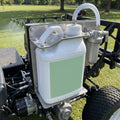
5L Selective Herbicide for Effective Weed Control
This 5L professional systemic penetrant selective herbicide combines three active substances to control a wide range of broad-leaved weeds in turf.
It is suitable for all managed amenity turf and amenity grassland, including golf courses, playing fields and sports pitches. Its active substances work against many broad-leaved weeds such as chickweed, knotgrass, speedwell and redshank.
Key Features
- Three active substances: Mecoprop-P, MCPA and Dicamba
- Systemic penetrant, selective herbicide
- Taken up by the plant mainly through the foliage
- Works best on small, actively growing target weeds
- Can form part of an integrated turf management programme to keep turf surfaces high quality and weed free
- Can be tank mixed with two other herbicides to tackle an even wider range of weeds – together these products control the vast majority of weeds found in turf
- Applied once per year at 5l/ha
Product Overview
| Product Type | Herbicide |
|---|---|
| Active Substance | 19.5g/l dicamba, 245g/l MCPA, 43.3g/l mecoprop-P |
| Formulation Type | Soluble concentrate |
| Areas of Use | Amenity grassland, managed amenity turf |
| Amateur/Professional | Professional |
Application window
| Jan | Feb | Mar | Apr | May | Jun | Jul | Aug | Sep | Oct | Nov | Dec |
|---|---|---|---|---|---|---|---|---|---|---|---|
| - | - | - | ✓ | ✓ | ✓ | ✓ | ✓ | ✓ | - | - | - |
Weeds Controlled
Treats a broad range of common broad-leaved weeds in grass and turf. It is especially effective on:
- Black bindweed
- Chickweed
- Fat-hen
- Forget-me-not
- Knotgrass
- Poppy
- Redshank
Further information on susceptible weeds is given on the product label.
Applications
- Amenity grassland: semi-natural or planted grassland that receives minimal or non-intensive management, including airfields and mainly grassed railway embankments and roadside verges.
- Managed amenity turf: frequently mown (i.e. at least once a week), intensively managed turf, including fields used for turf production. This can include public-use areas such as all kinds of sports turf, golf greens, tees and fairways.
How to Use
When to use
Apply to actively growing grass between April-September.
- Let newly sown turf establish before applying
- Control is most effective on young, actively growing weeds
Application method
- Apply to turf or grass with a vehicle mounted boom sprayer
- Apply at 5 l/ha in 170-400 l/ha of water
- Part fill the spray tank with clean water and begin agitation
- Add the correct quantity of this herbicide to the tank
- Top up the tank with the remaining water, continuing to agitate for thorough mixing
- Keep agitating until spraying is finished
- After use, clean all spraying equipment thoroughly inside and out, then fill the tank with clean water and leave it overnight
| Maximum Treatments | Application Rate | Water Volume | Application Method | Spray Quality |
|---|---|---|---|---|
| 1 per annum | 5L/ha | 170-400L/ha | Vehicle mounted boom sprayer | Medium |
Tank mix recommendations
To widen the range of weed species controlled, this herbicide can be tank mixed with two other herbicides. The second herbicide is well suited to annual weeds and broad-leaved perennials with a spreading habit, such as creeping buttercup, while the third herbicide controls many common broad-leaved and rosette-forming turf weeds.
Add the products to the tank in the order and at the rates below:
| Product | Application rate |
|---|---|
| This herbicide | 4 l/ha |
| Second herbicide | 1.2 l/ha |
| Third herbicide | 1.5 l/ha |
Use a water rate of 300-500 l/ha. Put half the water in the spray tank before adding the herbicides and the rest afterwards, agitating throughout for thorough mixing.
Specifications
- Pack size: 5L
- Active substances: 19.5g/l dicamba, 245g/l MCPA, 43.3g/l mecoprop-P
- Formulation: soluble concentrate
- Application rate: 5 l/ha (4 l/ha in the recommended tank mix)
- Water volume: 170-400 l/ha (300-500 l/ha in the recommended tank mix)
- Maximum treatments: 1 per annum
- Spray quality: Medium
- Application window: April-September
- User: Professional
Active Substances: Dicamba, MCPA and Mecoprop-P
Bio-chemical mode of action: all three active substances are synthetic auxin herbicides. Synthetic auxins trigger rapid, abnormal cell growth and development in the stems, petioles and leaves of susceptible plants, leading to cells bursting and, ultimately, death of the cells and the plant.
Mobility: all three are systemic penetrants, meaning they can move downwards through the plant in the phloem (sugar-conducting tissues) and upwards in the xylem (water-conducting tissues).
Application timing: systemic auxins perform best when weeds are actively growing, and are usually more effective on younger plants in their vegetative stages.
Resistance: resistance to synthetic auxins is still relatively uncommon, thought to be because these herbicides act on multiple sites. Even so, resistance has been recorded worldwide, with 36 species confirmed resistant as of 2017. Good practice, such as alternating with products that have a different mode of action and using cultural weed control, helps lower the risk of further resistance.
Notes
- Do not apply with hand-held equipment
- Do not roll or harrow the surface for at least a few days before or after application
- Do not apply in drought, when rain is forecast, or in cold or frosty weather
- Do not mow for 24 hours (closely cut turf) or 3 days (all other turf) before or after treatment
- Do not re-seed for 6-8 weeks after treatment
- Turf sown in spring may be ready to spray after about 2 months, but turf sown later in the year should not be sprayed for about 8 months
- Do not use the first 4 mowings for mulching unless they have been composted for 6 months
- Avoid contact with non-target plants
- For professional use only